

Inbreeding in the green tree python (Morelia viridis)
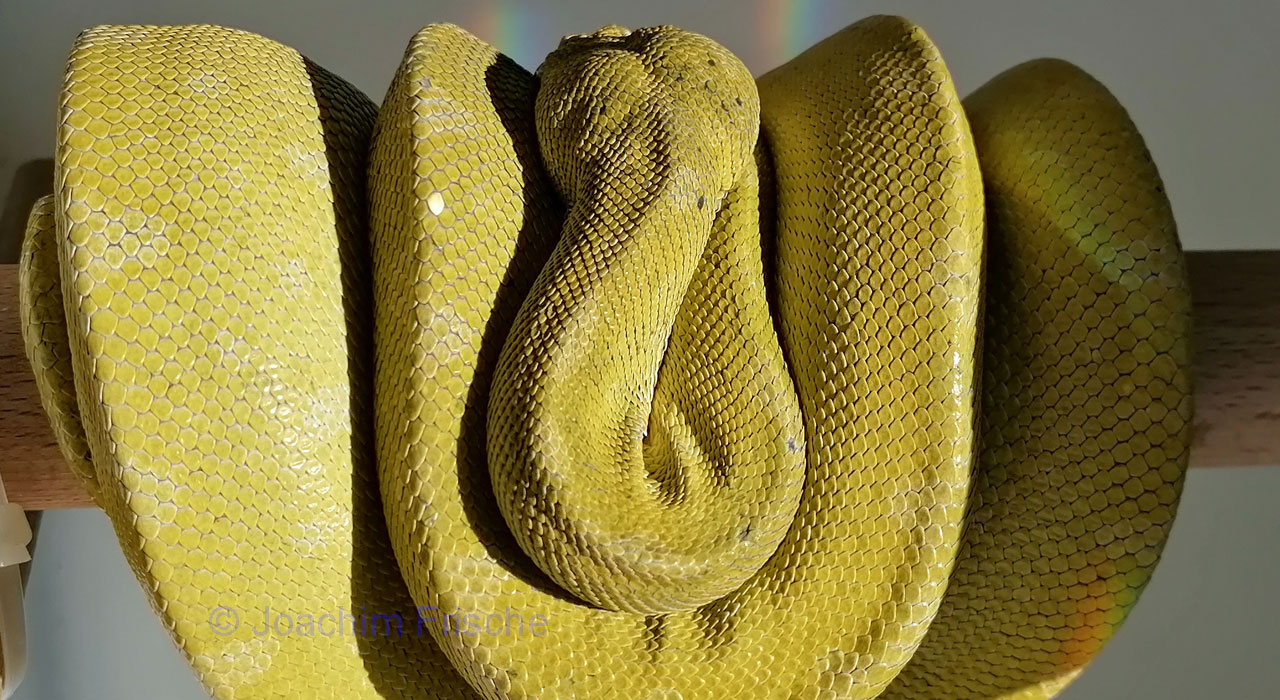
Inbreeding in the green tree python (Morelia viridis)
"Diversity of opinion means the existence of a multitude of different, independent opinions and sources of information, without any one of them occupying a dominant position."
With this deliberately chosen introduction, I would like to start a controversial topic, which will be dealt with in several parts.
Part 1: How to recognise inbreeding in Morelia viridis
In short: not at all.
In fact, only a DNA analysis of the intended parents can provide a reliable answer.
That's why I wrote to Proherper Labs in Genk.
Proherper Labs conducts genetic testing on reptile samples, primarily from Python reguis.
In addition to diseases, sex determination and colour variations are also analysed and determined.
The tests are carried out using samples taken from moulting remains and/or saliva.
I wanted to know whether DNA analysis was possible for Morelia viridis.
Die Antwort war „Unfortunately this isn’t possible“.
In order to assess siblings or related animals, the phenotype is sometimes used as an argument, or specific characteristics of a certain type, such as the pattern on the tip of the tail, are cited as a classification feature.
If animals look similar, there is a possibility that they are of the same type or perhaps even siblings.
This example shows that this is not the case:
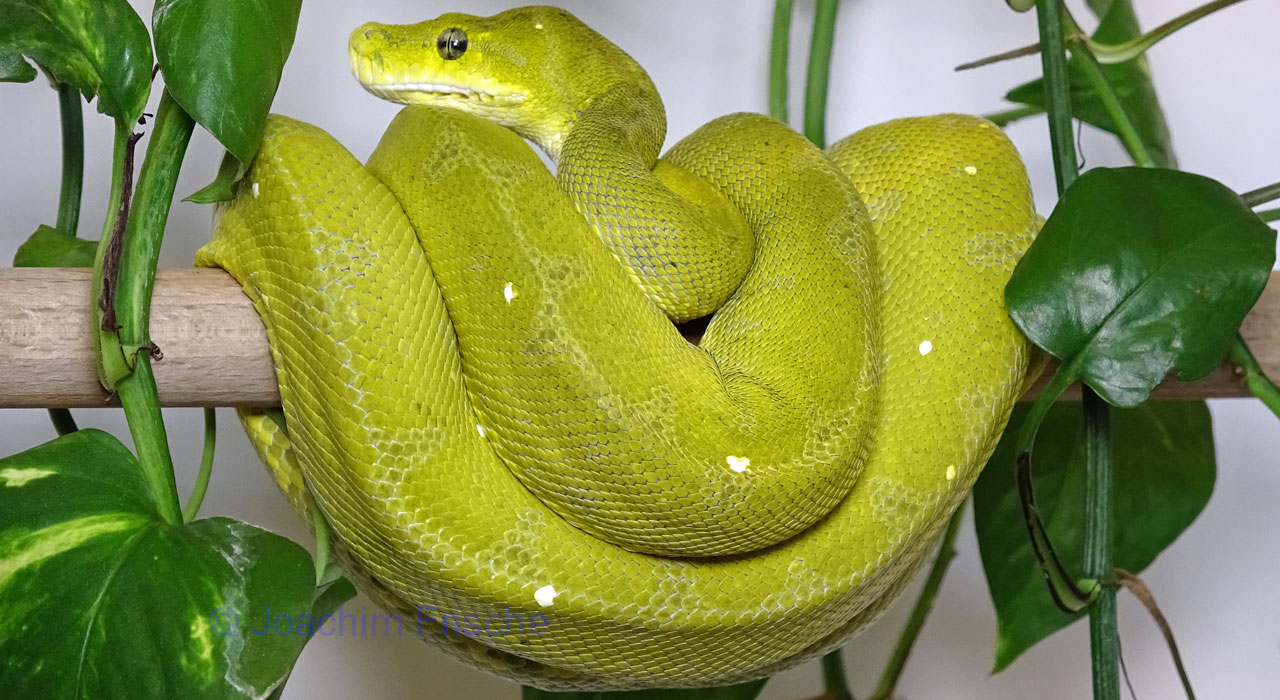
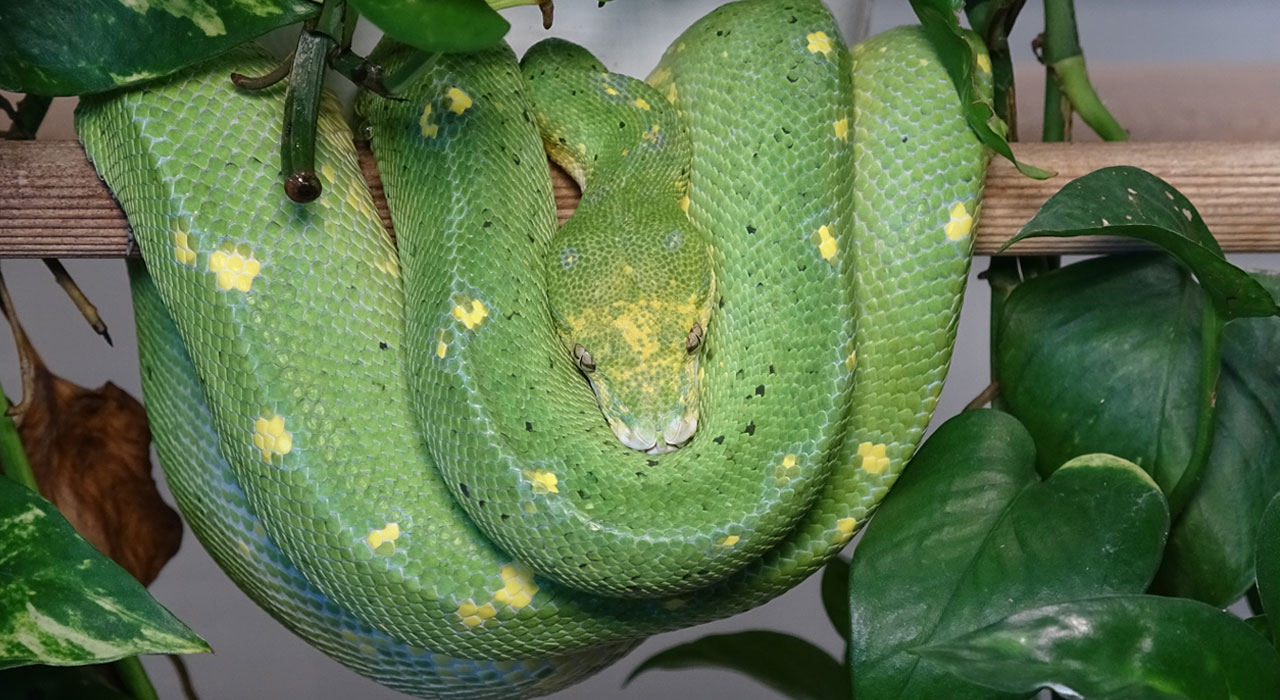
Sunflower and Freckle: both females come from a clutch laid by a sibling pair.
This leaves only a meticulously compiled and researched pedigree of the animal in my argument, which offers the possibility of identifying family relationships.
It was Marcus Kreklau (Fabulous German Tree Python) who offered to look into Americano's (AA-12-07) pedigree in 2018.
Until then, I had assumed that pedigrees were only kept for mammals (such as dogs, cats and horses).
Researching a family tree requires one thing: an incredible amount of time, which neither Marcus nor I had at the time.
So it was not until 2023 that I was able to devote myself once again to researching 'my' Morelia viridis.
Mine because they are animals that hatched and were raised by me in 2018.
The pedigree of all my snakes (except Frische No. 5 and Yuma) dates back to the 1970s and is so extensive that I have not yet found a reasonable way to have it printed or displayed in a legible format.
That's why I created a slimmed-down version of the family tree that fits on a 120 cm x 80 cm poster and is now legible.
In addition to Marcus Kreklau, Svenja Spitzer, Stefan Seidel, Jan Neuhaus and Marcel Hoffmann also provided valuable German-language support in compiling the family trees.
However, one thing must be mentioned: without the American breeders, the research would have remained incomplete.
Americans are fantastically networked and organised, and meticulous in their record-keeping.
There are two articles on the subject of family trees that can be found on my homepage.
Where possible, pedigrees are provided with key information such as a picture, breeder, year of birth and gender.
Here are two examples of a family tree that show how family relationships can be that at first glance do not seem to exist.
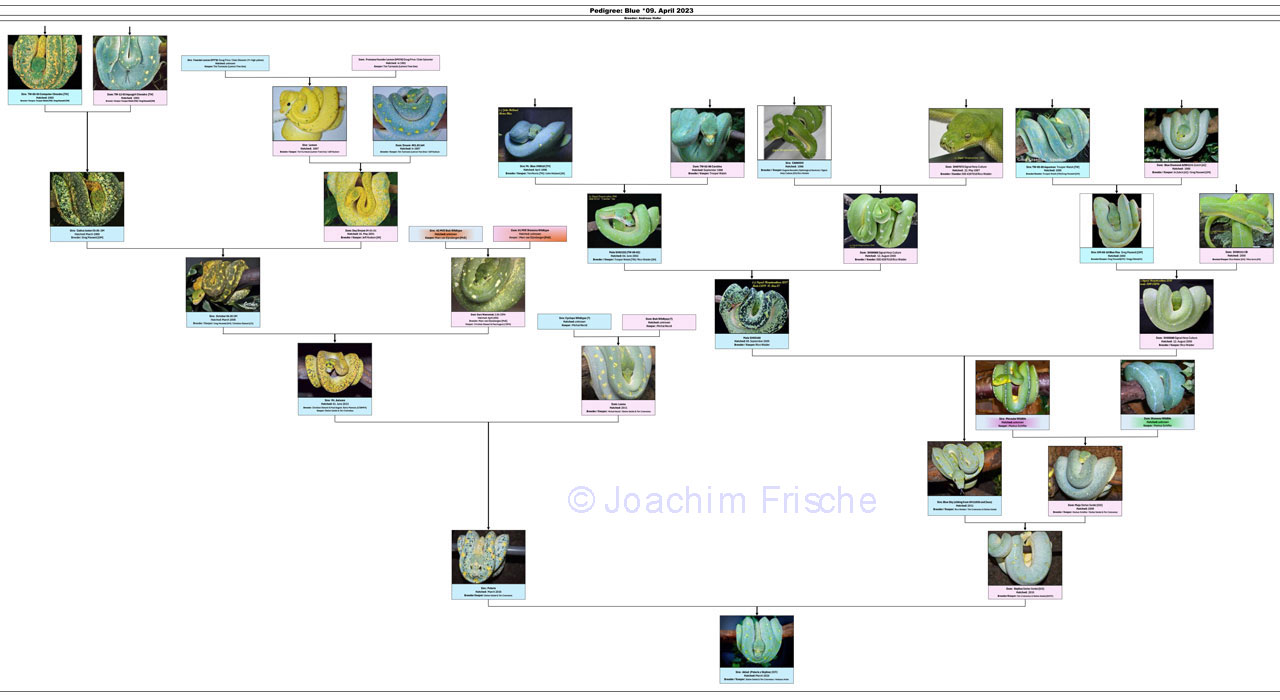
The example of a pedigree shown here is a small part of Blue's paternal line.
Blue comes from Andreas Hofer's breeding programme and, at first glance, has nothing in common with the animals I care for.
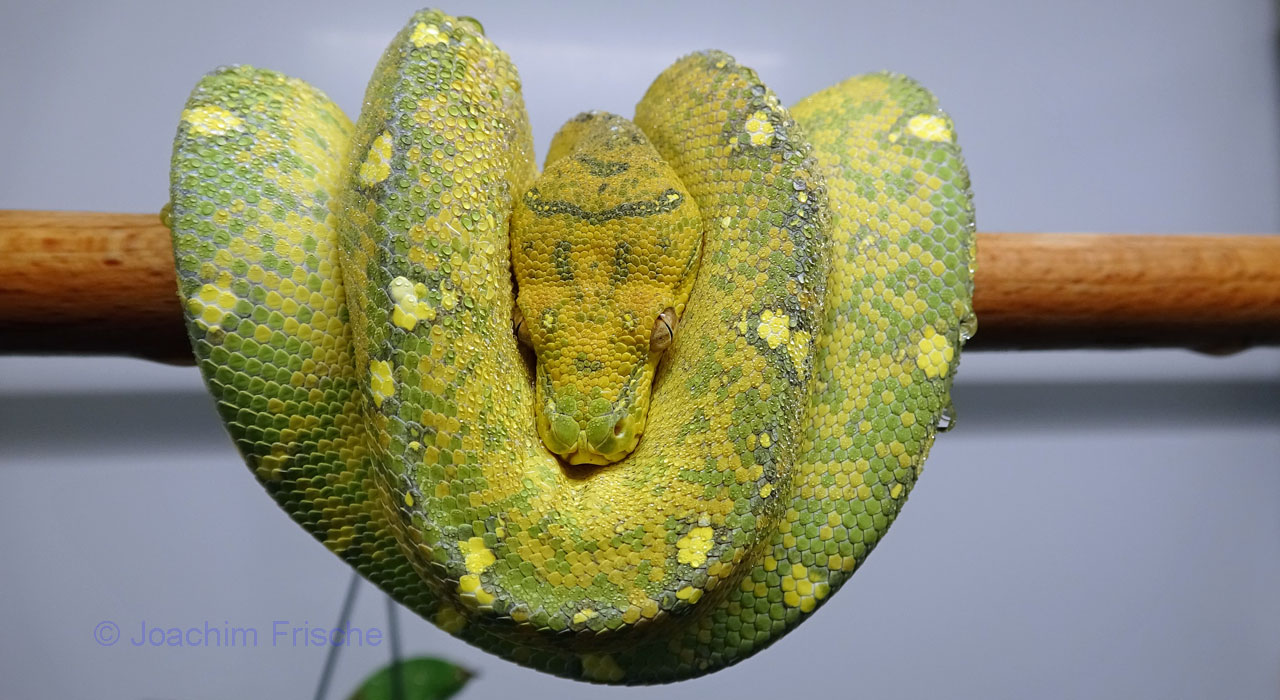
This genealogy shows that of Neonates from the year 2025.
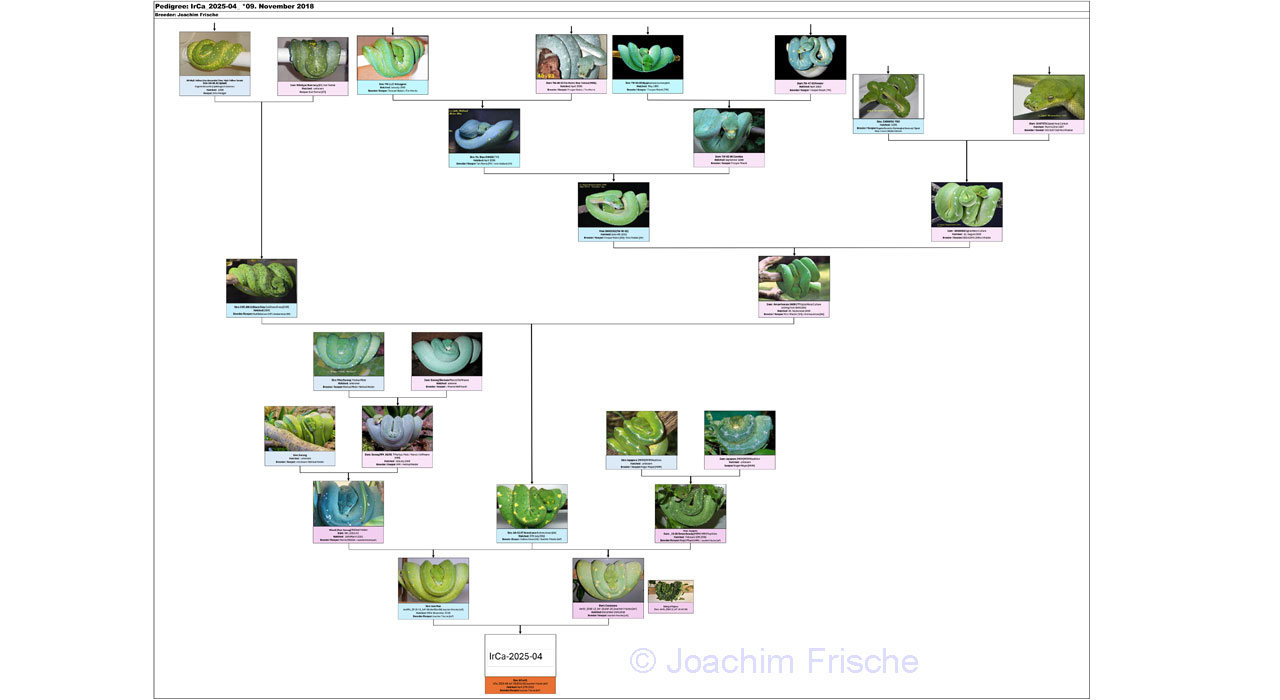
This pedigree shows a selection of the neonates that hatched in April. I hope you can see that Blue and IrCa-2025 have the same ancestors.
It can also be seen that the neonates with Americano have the same father.
However, the mothers are of different origins.
Würmli, Iron Man's mum, is a pure Sorong type.
Green Beauty, Cassiopea's mother, on the other hand, is a pure Jayapura type.
I hope I have succeeded in demonstrating how helpful a pedigree is when it comes to finding out how the animals being cared for are related.
The next part will deal with questions concerning inbreeding.
Part 2: The idea behind pairing Iron Man and Cassiopeia