

US Designer Chondros – part 5
The topic of US designer Chondros is so extensive that many articles will appear in the coming months.
A central element will be the Morelia viridis breeders of the last 40 years as well as some of the most spectacular lines that have emerged with the enthusiasm of these people.
Lines that have also found their way into Europe and Germany and have been and continue to be promoted by well-known breeders.
Before the first part of this series begins, we would like to thank those people and institutions without whose support and permission this series would not have been possible.

Herpetoculture Magazine: https://herpetoculturenetwork.com/
If you are interested in buying: https://www.magcloud.com/brose/issue/1850727

The Herpetoculture Network: https://www.facebook.com/theherpetoculturenetwork/

Creating Mr. Blue A (Not So) Short History
I would like to thank Tim very much for the pictures provided and for the permission to publish them.

Mid-Atlantic Arboreals: https://www.facebook.com/midatlanticarboreals/

Vibrant Viridis, LLC: https://www.vibrantviridis.com/
The story of Mr. Blue - Part 5
A (not so) short story by Tim Morris
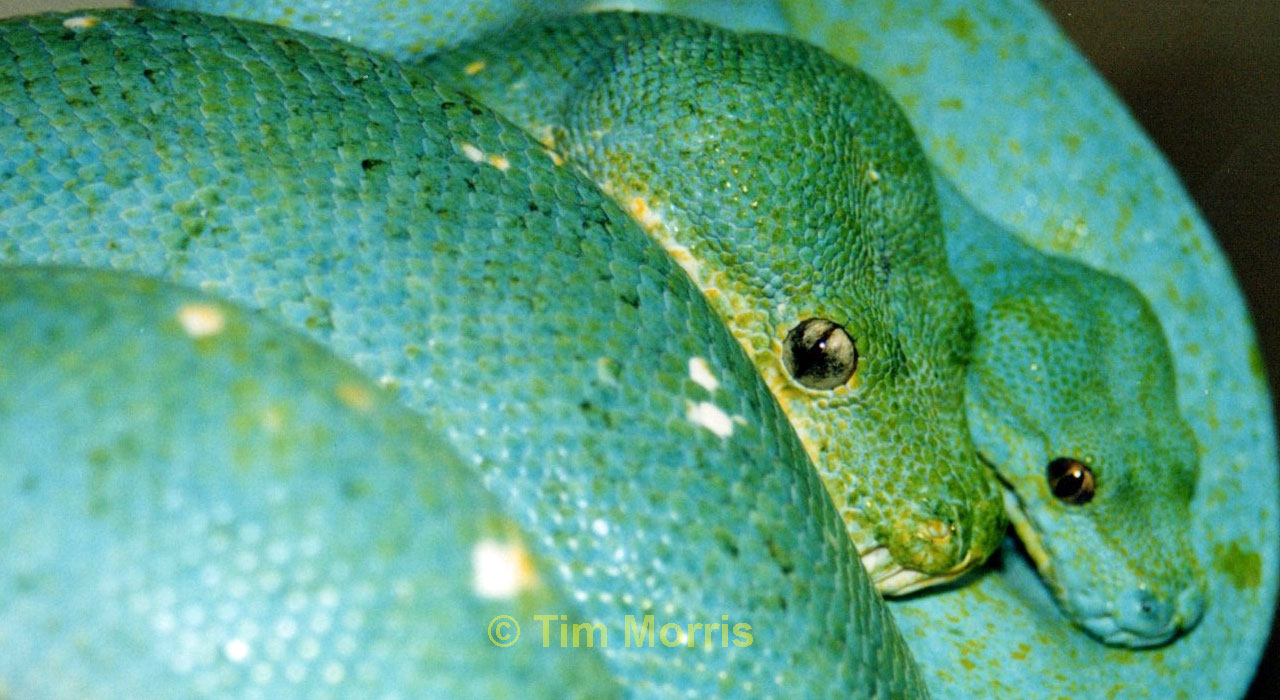
18.96, aka MR. Blue
The clutch described in Part 4 consisted of red/maroon neonates.
There was one conspicuous outlier among them - that was 18.96.
The special thing about this neonate was that it had clearly reduced markings.
From today's perspective, the fact that I offered this neonate at several exhibitions was embarrassing.
I would have liked $1000 instead of the usual $750, but the buyers showed no interest for this price.
I would like to mention that between the summer of 1996 and about 1998, the market for Chondros had collapsed in price.
Not because of too many animals, but because a large supply of freshly hatched neonates was offered for 200 - 300 $.
This behavior can still be found today when it comes to making a quick buck.
Buyers see the supposedly low price and not the advantage that a stable, older and food-resistant neonate is much easier to accustom to a new home.
Many simply couldn't resist these bargains; and that hasn't changed to this day.
Fall 1996:
The "Mid-Atlantic Reptile Show", or M.A.R.S. for short, opened its doors.
Most of the top breeders were interested in the show. Among them was Trooper, who only wanted to attend the show as an observer.
As Trooper's journey from his home meant that he would pass right by my apartment, I persistently persuaded him to visit me.
He could marvel at the bloodline he had created and also admire their descendants.
He agreed!
I was thrilled! I couldn't believe that this legendary person would pay a visit to my humble abode.
When he walked into my snake room (which was a converted second bedroom in a 2-bedroom apartment), he didn't say much.
Just the occasional "hmmm", "uh huh" or "very nice", but when I showed him the babies I had bred, we eyed 18.96 as well.
He stared at this neonate and muttered "uh huh... Tim, you might want to keep this animal..."
Such a reaction means that this Chondro will probably develop into "something really special".
From this point on, 18.96 never saw a trade fair again.
I got to know John Holland (alias Johnny Blue) through my nephew.
His company was called "Blue Region" and he thought what would fit the blue theme better than a blue snake!
We agreed a deal whereby we received cash plus 2 years breeding rights. During this time, we wanted to mate him (we now knew he was male) with his mother.
The idea was that this might produce more "super blue" animals.
48.93 aka TMBF
This female was the most fertile female green tree python I have ever known:
- successfully mated for the first time at just under 2.5 years old
- had to spend and endure a lot of reproductive effort and stress because 4 of her 6 litters were maternally cared for and two of the four litters were incubated by her one after the other
- no one else produced as many neonates as she did
Today, I attribute my status among the prominent historical breeders of the green tree python primarily to the fact that I was in the right place at the right time.
To be precise, I only bred the only two chondros I had.
At the beginning, of course, I had no idea what potential lay dormant in my terrariums.
In fact, it was Trooper and the other bloodline contributors who laid the groundwork for the results I achieved.
In this respect, I consider myself a very lucky chondro breeder.
End
The next article by John Irby will explain the Blue Line
Click here for the original article: Creating Mr.Blue