

US Designer Chondros – part 3
The topic of US designer Chondros is so extensive that many articles will appear in the coming months.
A central element will be the Morelia viridis breeders of the last 40 years as well as some of the most spectacular lines that have emerged with the enthusiasm of these people.
Lines that have also found their way into Europe and Germany and have been and continue to be promoted by well-known breeders.
Before the first part of this series begins, we would like to thank those people and institutions without whose support and permission this series would not have been possible.

Herpetoculture Magazin: https://herpetoculturenetwork.com/
Bei Kauf-Interesse: https://www.magcloud.com/brose/issue/1850727

The Herpetoculture Network: https://www.facebook.com/theherpetoculturenetwork/

Creating Mr. Blue A (Not So) Short History
I would like to thank Tim very much for the pictures provided and for the permission to publish them.

Mid-Atlantic Arboreals: https://www.facebook.com/midatlanticarboreals/

Vibrant Viridis, LLC: https://www.vibrantviridis.com/
The story of Mr. Blue – Part 3
A (not so) short story by Tim Morris
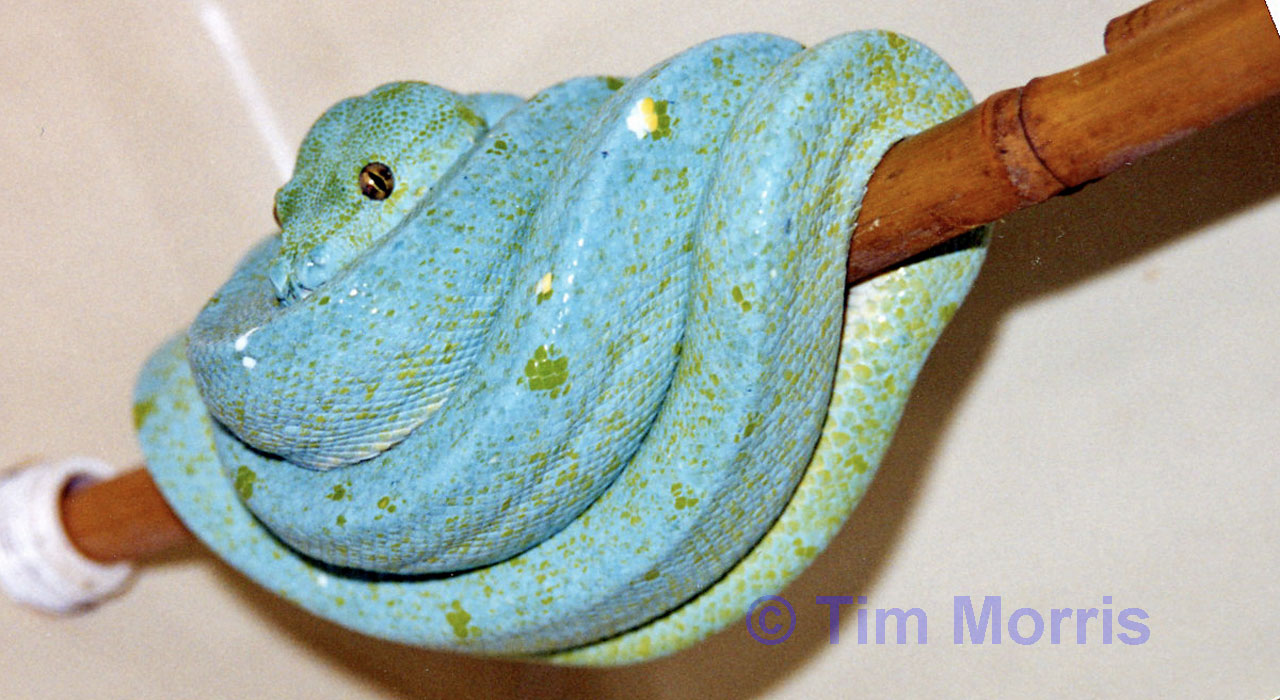
Winter 1995 – 1996
Since November, I have reduced the light from 12 hours to 10 hours. The daytime temperature has also been reduced from 11 to 9 hours.
At the same time, the night-time temperature was lowered to around 20 °C, while the maximum daytime temperature (measured at the uppermost berth under the heat lamp) remained unchanged at 30 °C.
I continued this cycle until the end of December.
I then increased the night temperature again to around 26 °C until the eggs were laid.
During this time I kept a close eye on where the female was.
When she spent most of her time in cool places, the temperatures were reduced somewhat.
However, if they preferred warm areas, I increased the temperature a little.
This kind of observation was the result of another of the many invaluable pieces of advice that Trooper gave me.
It read: "Observe your animals and learn from them. They will show you what they need."
During the last gestation period, I observed that the female preferred to stay mainly in the cooler area of the terrarium.
Her body temperature (measured with an infrared thermometer from Raytek) fluctuated accordingly.
At night, the body temperature was 27 °C.
During the day at around 30 °C.
The nesting box was placed in the terrarium in mid-December.
Until about 10 days before laying the eggs, she left the brood box from time to time.
From February 1, she stayed in the nesting box for good.
The eggs were laid on February 11 (1996), 15 days after the "Prelay Shed" which took place on January 27.
About three days before she laid her eggs, she drank some water for the last time.
At this point, the night setback was complete and an average temperature of around 28 °C was measured in the brood box.
Occasionally, the maximum temperature reached around 31 °C, while the lowest night-time temperature was measured at around 27 °C.
Another piece of information Trooper passed on was that the eggs produce their own heat as they develop.
He therefore recommended lowering the temperature in the nest box accordingly.
After about 6 weeks (with an expected 8-week incubation period) I turned the temperature down and the target value was now 27 °C.
Of course, the female would compensate for any difference accordingly and regulate the correct temperature.
Regardless of the ambient temperatures, the core temperature (measured with the Raytek) was kept constant between around 30 and 31 °C.
During the timing, I glanced at the female from time to time.
Occasionally I poked lightly between the coils to get a glimpse of the eggs.
She tolerated the interventions, and I learned that even if one (or more) eggs went bad during the incubation period, the good eggs were not affected.
A great relief, because otherwise I really wouldn't have known what to do!
On several occasions I observed the female sticking her snout directly into the clutch.
I assumed that she was checking the temperature inside the egg sac via the labial pits.
End Part 3
Click here for the original article: Creating Mr.Blue