

Molting
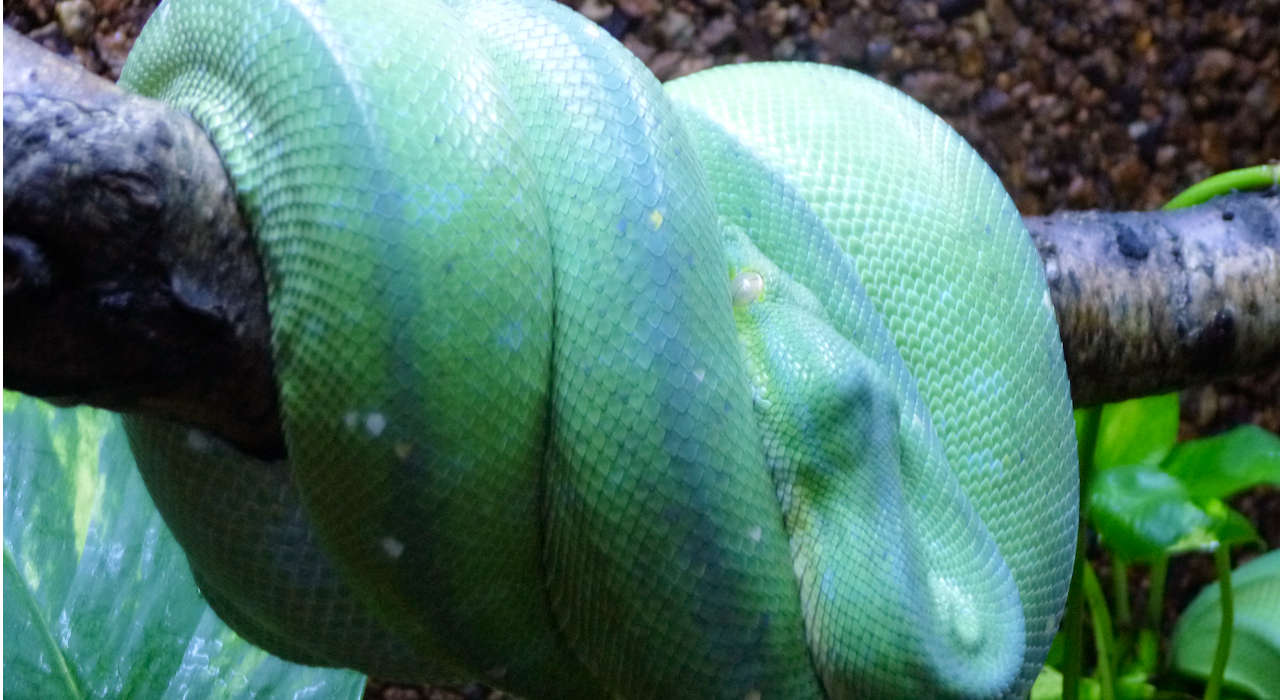
Molting - essential in the life of the Green Tree Python
Like all reptiles, the Green Tree Python is forced to shed its skin from time to time. The hormonally controlled molting takes place because the skin of a snake does not grow with it.
In the first few weeks as a neonate, Morelia viridis sheds its skin about every 4 weeks because the little ones naturally increase in length and girth.
With increasing age, the interval increases until it occurs only about every 3 months in adult animals.
The shedding of the skin is then no longer based on a growth phase, but primarily serves to get rid of parasites, dirt, and bacteria.
The onset of molting in adult specimens begins imperceptibly and is best recognized by the changing shape of the head, which appears stocky and misshapen.
The onset of moulting can be accompanied by a lack of appetite.
In the coming days, the shine of the body changes into a greyish, dull appearance. The eyes often cloud over.
In addition, the animals become sluggish and irritable. This is not surprising, since the loss of sight makes the green tree python uncomfortable.
Shortly before the moulting process, it happens that the milky coloring gives way to a normal one again. Until then about 10 days have passed. After about 14 days, the actual molting takes place, which can undoubtedly be recognized by the shed skin - also known as the viper's shirt.
Because Morelia viridis is defenseless during molting and about 24 hours afterwards. Does this snake shed its skin at night.
A high level of humidity is important so that the molting can be carried out without any problems, since a fine layer of air and water is pushed under the peeling skin, which separates the old skin from the body before the actual molting.
That explains the milky complexion of the skin.
It is perfect when the adder shirt is stripped off in one piece. Since the skin of Morelia viridis is thin, it often happens that the skin is irritated when it molts.
This can often be observed, especially if the animals have eaten shortly before.